

The relationship between legacy software engineering and AI engineering
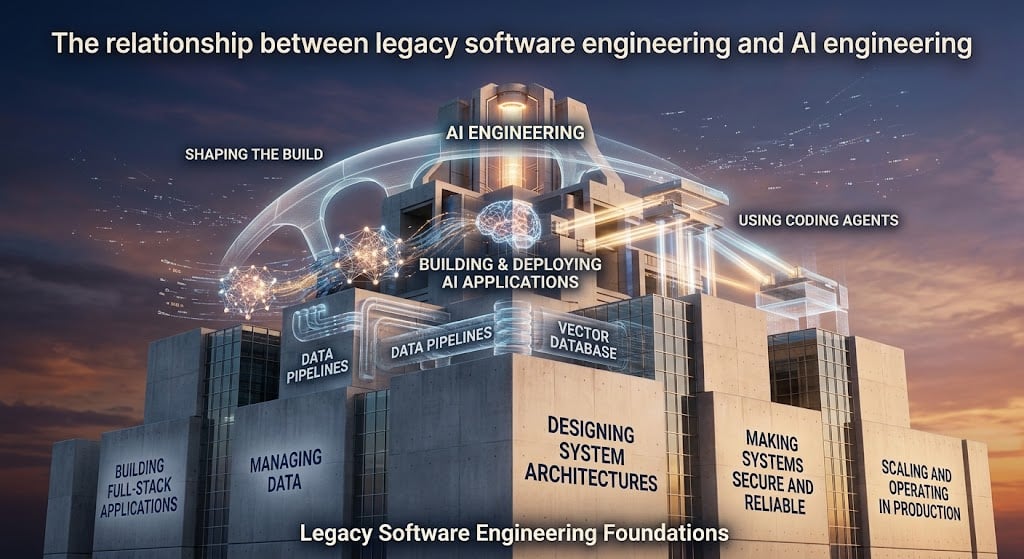
A lot of people see software engineering as totally different from AI engineering. But in truth, AI engineering is a layer built atop software engineering, meaning that software engineering forms the core foundations of what AI engineering means. The graph below explains that.
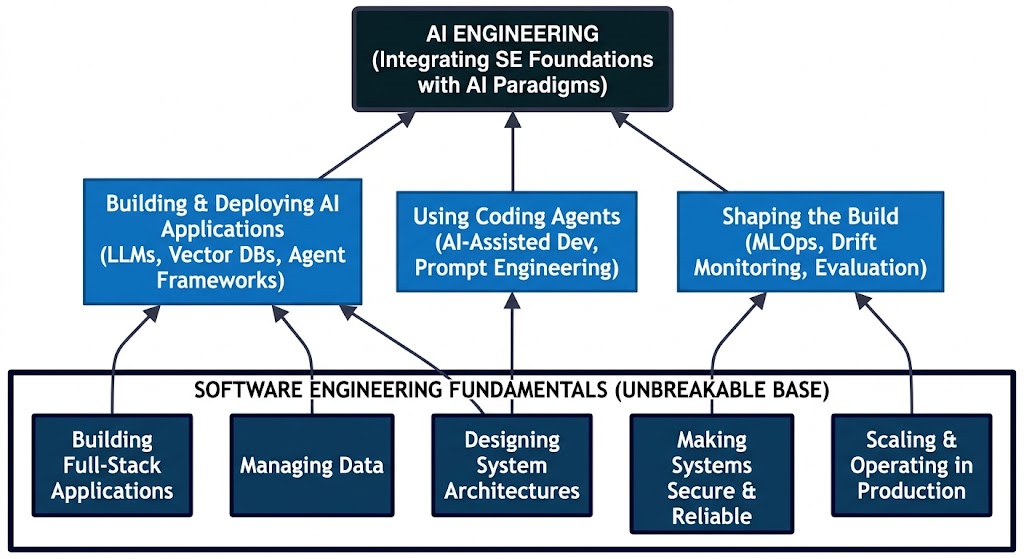
Software Engineering Foundations
Before writing a single prompt or deploying a model, every developer must recognize that software engineering fundamentals are the non-negotiable bedrock of modern technology.
Whether you are building a traditional web application or an agentic AI system, the rules of system execution, state management, security, and scalability remain unchanged.
The core difference between legacy software engineering and AI engineering isn't the underlying engine—it is the nature of the logic. Legacy software engineering is deterministic: you write explicit code to handle known inputs and produce predictable outputs.
AI engineering, by contrast, is probabilistic: it wraps non-deterministic models inside deterministic code, using probability to solve complex, unstructured problems. Because an AI model cannot exist in a vacuum, an AI engineer must still be a solid software engineer first.
Without robust architecture, reliable data pipelines, and production-grade security, an AI model is just an isolated script that cannot deliver real-world value.
Below are the five core foundations that support both traditional software systems and modern AI infrastructure:
Building Full-Stack Applications
Constructing the client-side user interfaces and backend logic that allow end-users to interact with an application.
Legacy Context: Building a web dashboard using React, routing traffic through a Python backend, and maintaining state persistence.
Managing Data
Designing storage schemes, maintaining integrity, and optimizing queries to move data quickly and accurately.
Legacy Context: Structuring relational schemas in PostgreSQL, writing complex SQL queries, and maintaining ACID compliance for transactional records.
Designing System Architectures
Planning how decoupled services communicate, route messages, and maintain performance under load.
Legacy Context: Implementing modular microservices, using message queues like Kafka for asynchronous processing, and defining tight API boundaries.
Making Systems Secure & Reliable
Guarding applications against unauthorized access and ensuring the system fails gracefully under anomalous conditions.
Legacy Context: Enforcing OAuth2 authentication, handling API error boundaries, mitigating OWASP vulnerabilities, and tracking metrics through continuous observability tools.
Scaling & Operating in Production
Deploying, hosting, and monitoring applications to guarantee low latency and high availability for active users.
Legacy Context: Building automated CI/CD pipelines, containerizing services with Docker, setting up load balancers, and establishing auto-scaling rules based on CPU/RAM usage.
AI Engineering Extensions (The AI Layer)
Building on top of software engineering fundamentals, this layer introduces the specific capabilities, tools, and paradigms that turn traditional software into AI engineering.
Rather than replacing core software principles, these components directly extend them—taking deterministic pipelines and pairing them with probabilistic intelligence, model APIs, vector storage, and autonomous agents.
Below is a detailed look at how each foundational pillar extends into the AI layer:
Building & Deploying AI Applications
Foundational Link: Extends Building Full-Stack Applications and Designing System Architectures.
Core Concept: Constructing end-to-end software applications that use large language models, semantic vector indexes, and agentic execution frameworks as core computational components.
Legacy Context: Writing server endpoints to process static data inputs, run business logic rules, and serve UI state.
AI Extension: Integrating LLMs into backend execution chains, setting up vector databases for semantic retrieval, implementing streaming UI state for real-time model outputs, and utilizing agent frameworks to execute multi-step tool calls.
Using Coding Agents & AI-Assisted Development
Foundational Link: Extends Building Full-Stack Applications and Designing System Architectures.
Core Concept: Leveraging autonomous coding agents and model-assisted workflows to accelerate code generation, refactoring, and automated test writing without compromising architectural standards.
Legacy Context: Manually writing boilerplates, hand-crafting integration tests, reading syntax documentation, and reviewing pull requests line-by-line.
AI Extension: Directing coding agents through structured prompt specifications, using AI for automated code generation and refactoring, generating unit and integration test suites automatically, and using model evaluation loops to audit code quality.
Shaping the Build (MLOps, Evaluation & Monitoring)
Foundational Link: Extends Making Systems Secure & Reliable and Scaling & Operating in Production.
Core Concept: Managing the production life cycle of non-deterministic systems through continuous evaluation, performance tracking, model drift monitoring, and cost control.
Legacy Context: Monitoring system metrics like server CPU utilization, HTTP error codes, RAM overhead, and standard uptime logs.
AI Extension: Establishing MLOps pipelines to monitor context drift and hallucination rates, tracking token usage costs per request, running continuous benchmark evaluations against model updates, and implementing dynamic prompt caching to keep latency low.
Summary
AI engineering is not a standalone discipline created from scratch—it is the direct evolution of software engineering.
The upper layer of AI applications, coding agents, and MLOps cannot function reliably without the underlying foundation of full-stack development, structured data management, system architecture, security, and production scaling.
By mastering the core software pillars first and layering specialized AI mechanisms on top, engineers build intelligent systems that are not just impressive in theory, but secure, scalable, and resilient in production.


